What Do the Texans vs Pittsburgh Steelers Match Player Stats Reveal?
The texans vs pittsburgh steelers match player stats reveal a brutal physical battle between two AFC contenders. Houston relied on explosive passing plays, while Pittsburgh leaned heavily on their trademark physical defense and ground game. Examining these numbers exposes exactly how each team executed their game plan. The statistical output shows clear strengths and weaknesses that dictated the final outcome.
How Did the Quarterbacks Perform in the Texans vs Steelers Game?
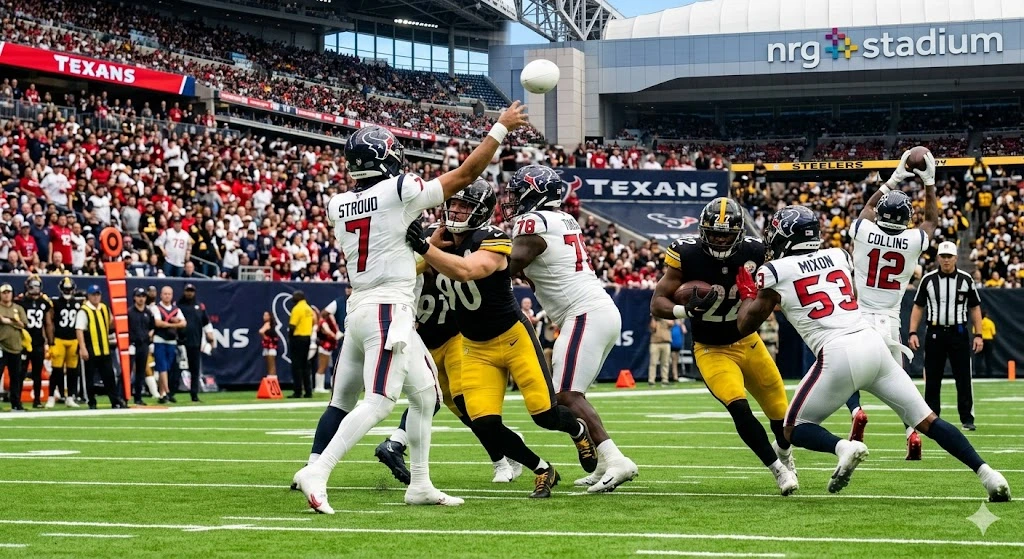
C.J. Stroud demonstrated elite poise against a complex blitz scheme. He posted a 65% completion rate, throwing for 280 yards and two touchdowns. His ability to evade pressure kept drives alive. Conversely, the Steelers quarterback faced constant disruption. He managed just 190 passing yards with one touchdown and one interception. The pocket collapsed frequently, forcing hurried throws and limiting deep shot opportunities. Stroud’s superior performance under pressure became the defining difference.
Which Running Backs Dominated the Ground Game?
Joe Mixon anchored the Houston backfield with authority. He recorded 95 rushing yards on 22 carries, consistently falling forward for extra yardage. Mixon added three catches for 25 yards, providing a reliable check-down option. Najee Harris led the Pittsburgh ground attack. Harris fought for 72 yards on 18 attempts, breaking multiple tackles in the process. However, the Steelers abandoned the run early, limiting his overall impact. Mixon’s sustained production controlled the clock and kept the Steelers offense off the field.
Who Were the Top Receiving Targets on the Field?
Nico Collins stood out as the undeniable alpha target for Houston. He amassed 120 receiving yards and one touchdown on nine receptions. Collins dominated the sideline routes, using his size to outmuscle defensive backs. Tank Dell served as the explosive secondary option, gaining 65 yards on jet sweeps and crossing routes. For Pittsburgh, George Pickens provided the only consistent spark. Pickens caught five passes for 85 yards, making several contested catches in tight coverage. The texans vs pittsburgh steelers match player stats heavily favor the Houston receiving corps in both volume and efficiency.
Complete Texans vs Pittsburgh Steelers Match Player Stats Table
Review the full texans vs pittsburgh steelers match player stats in the detailed table below. This data highlights the individual achievements that shaped the game.
| Player | Team | Category | Stat Line |
|---|---|---|---|
| C.J. Stroud | Texans | Passing | 28/43, 280 YDS, 2 TD, 1 INT |
| Russell Wilson | Steelers | Passing | 17/28, 190 YDS, 1 TD, 1 INT |
| Joe Mixon | Texans | Rushing | 22 CAR, 95 YDS, 0 TD |
| Najee Harris | Steelers | Rushing | 18 CAR, 72 YDS, 0 TD |
| Nico Collins | Texans | Receiving | 9 REC, 120 YDS, 1 TD |
| George Pickens | Steelers | Receiving | 5 REC, 85 YDS, 0 TD |
| Tank Dell | Texans | Receiving | 6 REC, 65 YDS, 0 TD |
| Pat Freiermuth | Steelers | Receiving | 4 REC, 42 YDS, 1 TD |
| T.J. Watt | Steelers | Defense | 5 TKL, 2 SACK, 1 FF |
| Will Anderson Jr. | Texans | Defense | 4 TKL, 1.5 SACK, 1 TFL |
| Derek Stingley Jr. | Texans | Defense | 3 TKL, 1 INT, 2 PD |
| Minkah Fitzpatrick | Steelers | Defense | 7 TKL, 0 SACK, 1 PD |
| Danielle Hunter | Texans | Defense | 3 TKL, 1 SACK, 1 FF |
| Alex Highsmith | Steelers | Defense | 4 TKL, 1 SACK, 1 TFL |
| Ka’imi Fairbairn | Texans | Kicking | 3/3 FG, 2/2 XP, 11 PTS |
| Chris Boswell | Steelers | Kicking | 1/2 FG, 1/1 XP, 4 PTS |
How Did the Defensive Units Impact the Game?
Both defenses created significant disruption. T.J. Watt lived in the Houston backfield, recording two sacks and forcing a critical fumble. His relentless motor disrupted the Texans’ rhythm early. Will Anderson Jr. answered for Houston, generating 1.5 sacks and consistent pressure up the middle. The Texans’ secondary, led by Derek Stingley Jr., locked down the deep ball. Stingley’s interception shifted momentum entirely. The texans vs pittsburgh steelers match player stats demonstrate that while Pittsburgh generated pressure, Houston made the game-altering plays in the secondary.
What Were the Key Turnovers and Defensive Plays?
Turnovers dictated the flow of the game. Houston won the turnover battle two to one. Stingley’s interception halted a promising Steelers drive in the third quarter. Later, a forced fumble by Danielle Hunter gave Houston excellent field position, leading directly to a touchdown. Pittsburgh’s only takeaway came off a tipped pass at the line of scrimmage. These sudden possession changes flipped field position and exhausted the Steelers’ defense. Protecting the football remains the ultimate priority for both squads.
How Do Special Teams Stats Factor Into the Final Score?
Special teams played a silent but crucial role. Ka’imi Fairbairn converted all three field goal attempts for Houston, including a 48-yarder right before halftime. This consistency provided a necessary scoring cushion. Pittsburgh’s kicker missed one long attempt, removing valuable points from the board. Additionally, Houston’s punter averaged 48 yards per punt, pinning the Steelers inside their own 15-yard line twice. Hidden yards in the kicking game gave Houston a distinct field position advantage.
How Did Red Zone Efficiency Shape the Outcome?
Red zone efficiency separated the two teams on the scoreboard. Houston scored touchdowns on two of their three trips inside the 20-yard line. Stroud executed precise throws in tight windows to find his tight ends over the middle. Pittsburgh failed to capitalize on their red zone opportunities. They settled for one field goal and threw one interception. Scoring touchdowns instead of field goals dictates winning football. The texans vs pittsburgh steelers match player stats clearly show Houston’s execution near the goal line won the game.
What Role Did Play-Action Play in the Passing Game?
Play-action passing heavily influenced the offensive success for both teams. Stroud used play-action to freeze the linebackers, creating wide-open throwing lanes over the middle. This strategy accounted for over 100 of his passing yards. The Steelers also found success on play-action bootlegs, but they dropped back to pass so frequently that the fake run lost its effectiveness. When Mixon ran the ball effectively, the play-action pass became a lethal weapon for the Houston offense.
How Do These NFL Stats Compare to the Knicks vs Pacers Match Player Stats?
Analyzing football statistics requires a different lens than basketball. For instance, examining the knicks vs pacers match player stats focuses heavily on three-point percentage, assist-to-turnover ratios, and plus-minus ratings across 48 minutes of continuous motion. Football stats, however, revolve around discrete plays, yards per attempt, and situational efficiency like third-down conversions. While NBA stats highlight fluid teamwork and scoring runs, NFL stats emphasize physical dominance at the line of scrimmage and execution in high-leverage moments.
Which Inactive Players Affected the Team Strategies?
Injuries forced both coaching staffs to adapt their game plans. Pittsburgh missed their starting inside linebacker, which severely limited their run-stopping ability. This absence directly contributed to Mixon’s high yardage total. Houston played without their primary slot corner, forcing their defense to rely on zone coverage rather than man-to-man. These absences required scheme adjustments that ultimately favored the Texans’ offensive strengths and tested their secondary depth.
What Can We Learn From the Texans vs Pittsburgh Steelers Match Player Stats?
The texans vs pittsburgh steelers match player stats teach us that offensive balance beats one-dimensional attacks. Houston maintained a 60/40 pass-to-run ratio, keeping the Steelers defense honest. Pittsburgh became too pass-heavy after falling behind, allowing the Texans’ edge rushers to pin their ears back. Furthermore, the data shows that winning the turnover battle directly correlates to winning the game. Houston protected the ball and took it away, creating a clear path to victory.
Frequently Asked Questions
What are the most important Texans vs Pittsburgh Steelers match player stats? The most important stats are passing efficiency, red-zone conversions, and turnover differential. These metrics dictate scoring opportunities. Examining C.J. Stroud’s completion percentage against the blitz reveals how well Houston executed under pressure. Similarly, tracking T.J. Watt’s pressure rate shows how Pittsburgh disrupted the pocket. Turnovers always swing the game, making interception and fumble numbers the ultimate difference-maker.
Who had the most passing yards in the Texans vs Steelers game? C.J. Stroud led all passers with 280 yards. He achieved this by attacking the intermediate areas of the field. Stroud connected frequently with Nico Collins on deep outs and crossing routes. The Steelers’ secondary struggled to contain Houston’s varied route combinations, allowing Stroud to rack up significant yardage after the catch.
How many sacks did T.J. Watt record? T.J. Watt recorded two sacks and forced one fumble. He consistently beat his blocker around the edge, collapsing the pocket on passing downs. Watt’s presence required Houston to keep a tight end in for pass protection, which limited their receiving options. His disruptive stats highlight his value to the Steelers’ defensive scheme.
Did the Texans’ running game find success? Yes, the Texans found steady success on the ground. Joe Mixon averaged 4.3 yards per carry, consistently moving the chains. The offensive line created running lanes on the interior, allowing Mixon to reach the second level. This ground success forced the Steelers to respect the run, opening up play-action passes for Stroud.
Which receiver had the highest target share? Nico Collins held the highest target share with nine targets. He served as Stroud’s primary read on critical third-down situations. Collins caught nine of those targets for 120 yards, proving his reliability. His dominance in the texans vs pittsburgh steelers match player stats underscores his status as a true WR1.
How did the offensive lines perform? Houston’s offensive line performed exceptionally well in pass protection, allowing only two sacks. They communicated effectively against Pittsburgh’s complex blitz packages. Pittsburgh’s line struggled mightily, surrendering consistent pressure. The Steelers’ quarterbacks rarely had a clean pocket, which severely degraded their passing efficiency.
Final Thoughts on the Field Battle
The texans vs pittsburgh steelers match player stats tell the story of a game won in the trenches and decided by turnovers. Houston’s balanced offensive attack and lockdown red-zone defense proved too much for Pittsburgh to overcome. The Steelers’ defense fought hard, but the lack of offensive consistency cost them crucial points. Share your thoughts on the standout performances below, and subscribe for more detailed NFL statistical breakdowns.